The Power of a Slur

The Tamalpais Union High School District encourages its teachers and pro-name change supporters to falsely accuse community members of being “racist” while the district’s lackluster efforts to close the achievement gap have failed students of color

By John Geluardi

The thing about carelessly using the term “racist,” is that it harms the recipient unfairly even if the taunt is without merit.  The false slur is not a reasoned argument. It’s a radioactive slander that is both powerful and easy to use. It requires no intellect, no skill and no meaningful understanding, only the willingness to wield it mindlessly at anyone the user wants to intimidate or groundlessly cause damage to.  

Once falsely accused of being a “racist,” the damage to your reputation can cost a job, cause you to be shunned in your community, and eyed with suspicion in social circles. The slander, even if false, is difficult to deny and the act of explaining that you’re not a racist, has the chilling effect of making you seem even more guilty of being one.

In other words, the spurious use of the term “racist” is a perfect tool for bullies, dullards and the entitled who lash out when the world has not immediately bend to their will.

The Tamalpais Union High School District and the Sir Francis Drake High School Administration are well aware of the power of the false racist accusation and has encouraged the term to be used to bully community members who are opposed to renaming Drake High School. The slander has become the predominant tool in the district’s quest to impose the name change on the community that has supported the high school for nearly 70 years.

There may, or may not be, a valid argument for changing the school’s name, but if so, it’s hard to discern among the taunts, slander and slurs.  The school district’s support of such a vulgar bullying tactic is ironic given the district’s inability to overcome its institutional racism to close the achievement gap, which particularly undermines black and Hispanic students. Not to mention such hostile tactics set a particularly worrisome example for students as a whole.
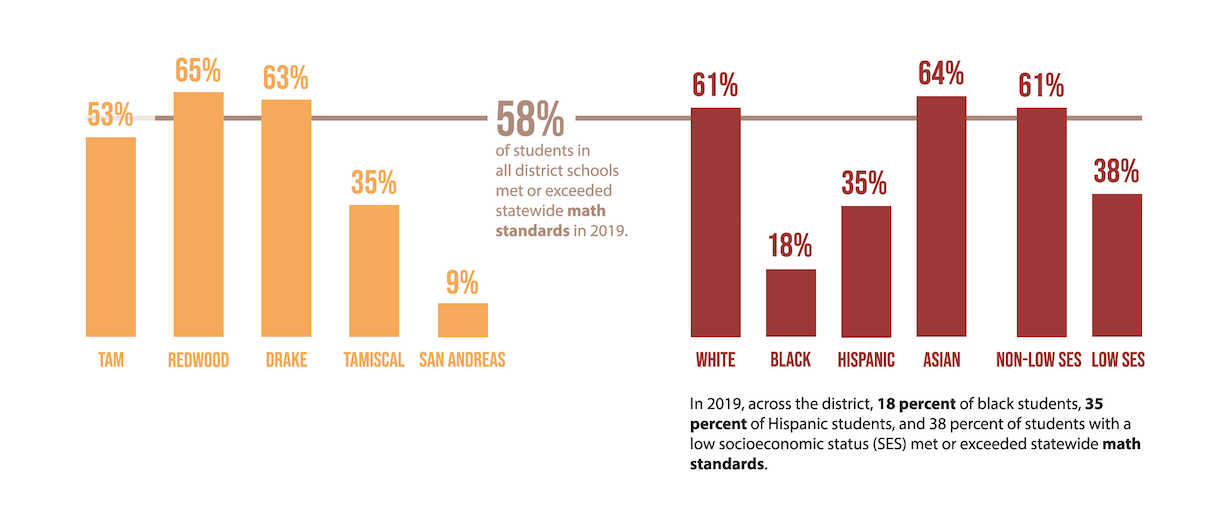
2019 statistics for the Tamalpais Union High School District showing the failure of teachers to address the achievement gap


The slander is used at public meetings by re-naming supporters, a group largely comprised of recent graduates that are organized, in part, by Drake faculty members, according to district emails obtained through the California Public Records Act. Video recordings of those meetings can be found at the district and high school’s websites. It’s rare that individuals are personally attacked with slurs, rather the slander is typically used to attack any good faith comments or ideas or items of historical record that do not conform to the school district’s rigid orthodoxy.

Only once during a Drake “listening session” held on Sept 10, 2020 did Drake Principal Liz Seabury insist that an overzealous name change supporter not use slurs in his public comments. But shortly afterwards, supporters resumed making, unchecked, derogatory remarks that also included similar terms such as “white supremacist,” and “colonialist”    

It’s worth noting that the movement to change the school’s name did not originate from a grassroots, community effort. The effort is driven by the Tamalpais Union High School District, a powerful institution that has used its influence and leverage to impose its will on any faculty members who may disagree with the district’s tactics and silence parents who are reluctant to risk displeasing the politically driven institution that educates their children.

This despite the fact that community members have financed the district’s renaming effort thus far with their tax dollars that have paid for a battery of attorneys who work for the expensive San Francisco law firm, Dannis Woliver Kelley.

The school district’s racist slur tactic has had a chilling effect. Members of the public who have became reluctant to make comment at public meetings. Longtime family supporters of the high school, who are respected in the community, have shied away from taking leadership roles in opposing the name change. Drake students, fearful of teacher retaliation, don’t express their opinions openly and even students of color, 64 percent of whom disapprove of the name change, have been ignored by the all-white Board of Trustees and all-white Drake faculty.

The school district also appears to be working with the support of the Marin County District Attorney’s Office, which has thus far turned a blind eye to the school district’s illegal activities, which include vandalism, misappropriation of funds, violations of the Brown Act and the unexplained disappearance of seven decades of Drake High School’s academic achievement awards, athletic trophies and drake-based artwork.  

Drake students don’t express opinions for fear of teacher retaliation and because teachers say they don’t care.

Perhaps most disturbing, parents on the Drake Leadership Council (DLC), which is made up of the teachers, parents and students that was tasked with deciding whether to change the school’s name. But school administrators denied the council information critical to making a properly reasoned decision. The school district denied the council any financial information about the impact of the estimated half-million cost of school’s renaming. The district also refused to give the council any details about where exactly that money will come from. The council was also denied an accounting of the estimated $75,000 to $100,000 that has been spent on the name change so far, most of which was paid by taxpayers for attorney fees.

The DLC was not even allowed to discuss the possibility of spending that money on programs that could help close the school’s shameful and pernicious achievement gap, which is directly hurting students of color, perhaps irreparably. Students on the council also asked for a comprehensive poll of students and community members but the request was denied by the school administrators who are managing the council. The council was allowed to conduct a partial poll, which showed the strong majority of students of color are against the name change.

On the face of it, the school district’s nondisclosure of public information was reckless and was clearly designed by the school district to control the outcome of the council’s action. An action whose only value is symbolic. The name change will have no meaningful impact on student achievement but will give self-serving boasting rights to the conspicuously white school board trustees, activist teachers and high school administrators.

It was no surprise that the two Drake Leadership Council Members who voted against the name change were both students of color.

The school district’s most alarming bully tactic has been its refusal to allow the DLC the opportunity to discuss possible alternatives to the name change, such as possible program solutions to the widening achievement gap. It’s telling of the district’s philosophy that it encourages its teachers to celebrate self-serving white saviorism, while students of color fall further and further behind and school district leaders are in a back room greedily polishing the crown jewel of institutional racism, the achievement gap.

Leave a comment

Filed under Sir Francis Drake High School, Uncategorized

Drake council prepares to approve high school renaming

By John Geluardi

After inciting student vandalism, protecting a parent who vandalized school property, intimidating community members and misappropriating thousands of taxpayer dollars on a project yet to be approved, the Tamalpais Union High School District has settled down to carry out a slightly more decorous process of renaming of Sir Francis Drake High School.

In September, the High School empaneled the Drake Leadership Council (DLC), an 18-member council that includes teachers, students, parents and Drake Principal Liz Seabury. The DLC is tasked with several objectives in changing the school name. The first is deciding to actually change the school name at an estimated cost of $430,000, which administrators claim will be paid for by contributions and grants. If the DLC decides to move forward with the renaming, the next step will be choosing the new name from a list of hundreds of suggestions.

The DLC may take the fist step at their next meeting on Thursday, Nov. 19. The DLC has met four times since Sept. 9. The meetings have included presentations from stakeholder groups including Coastal Miwok representatives, an alumni group and a racial equity panel. In addition a clinical therapist who specializes in multicultural counseling offered the DLC members some guidance on their decision process.

Should the DLC choose a new name, it will be presented to Superintendent Tara Taupier and the final decision will be made by the Tamalpais Union School District Board of Trustees who are expected to rubberstamp any new name the DLC brings forward.

The name Sir Francis Drake became controversial recently because the British naval officer was involved in two slave trading voyages early in his career and according to Drake teachers that fact causes physical pain to students of color, particularly indigenous students. But opponents to the renaming say Drake is a symbol of redemption because he renounced the slave trade at 23 years old and became a staunch advocate against slavery. In fact, when Drake arrived in Marin County in 1579, his crew included freed black slaves and all crewman were equally compensated, according to Drake historian John Sugden. And, according to Sugden, Drake’s crew was more diverse than the high school’s current faculty.

Thus far, the renaming process has been characterized by secrecy, heavy-handed tactics that include faculty incited vandalism, abuse of the law and district policy. There has also been public verbal abuse and intimidation of community members and the undisclosed expenditures of large sums of taxpayer funds prior to the project’s approval.

 By contrast, the DLC meetings have been businesslike and run efficiently, often under the leadership of impressively dedicated and earnest students though Drake teachers and Principal Seabury have drastically restricted what information the students and parents can review as they prepare for their decision, which will have a significant impact on the school’s budget and curriculum.

The district’s tactics have created so much controversy and unnecessary division in the community, school administrators brought in Lagleva to speak with the DLC at its meeting on October 29. Lagleva offered the DLC possible pathways to think through their pending decision on the controversial name change.

“I don’t profess to have any answers,” Lagleva said in a solicitous voice at the DLC meeting. “I only give perspective.”

Lagleva suggested that DLC members try to shift their understanding of the issue away from history and think more about personal and community values. “You need to get to the core of who you are as individuals, as a group, as a system,” Lagleva told Site Council members. “History is important to look at, but we can all agree that there are different interpretations and revisions of history depending on which lense you’re looking through.”

Lagleva added that decisions like the one the DLC is wrestling with will likely be decided by the institution, (the Tamalpais Union High School District) that is overseeing the process which means one group or another will be upset. But if things are carried out in a fair manner, it’s the best possibility of heeling community divisions after the decision. “If the process is as clean and as intentional and as transparent as it can be, you will arrive at a place that will reduce the risk of future discord,” Lagleva said.

Lagleva said he was neutral in the debate though he did reminded DLC members that a name change will only be a gesture. “It’s a symbolic choice about what the name represents,” Lagleva said. “A name isn’t going to change anything in terms of achievement.”

The race-based achievement gap, is a sore spot for the Tamalpais Union High School District and Drake teachers. According to the 2019 California Assessment of Student Performance and Progress test, there are huge, districtwide disparities in student proficiency in math and literacy standards. In all district schools, 58 percent of students met or exceeded statewide math standards in 2019.

When the test results are broken down to racial groups, the realities are disturbing. Asian students received the highest scores with 64 percent meeting or exceeding state math standards and whites scoring 61 percent. Only 35 percent of Hispanic students met standards for math. African American students fared the worst with only 18 percent scoring at, or exceeding, state standards.

There are many reasons for the discrepancies in student achievement according to a 2000 Carnegie Corporation study. Socioeconomic conditions are a big contributor, but most factors are related to teaching behaviors. Teacher shortcomings include inabilities to recognize struggling students, racism, internalized beliefs about student abilities, insensitivities to student challenges, low expectations and teachers’ inability or unwillingness to self-reflect.   

These are not insurmountable obstacles. Nonetheless the district’s gap in achievement have been consistent for years. Sir Francis Drake High School’s test results are similar to county averages, However, as Drake considers spending an estimated $430,000 on a symbolic gesture, the DLC should consider if the time and money spent on the name change project is of best value to students, teachers and the community. But the DLC has only minimally discussed the financial implications of the name change. There has been no discussion of funding academic programs or self-awareness training for teachers that might help close the achievement gap.

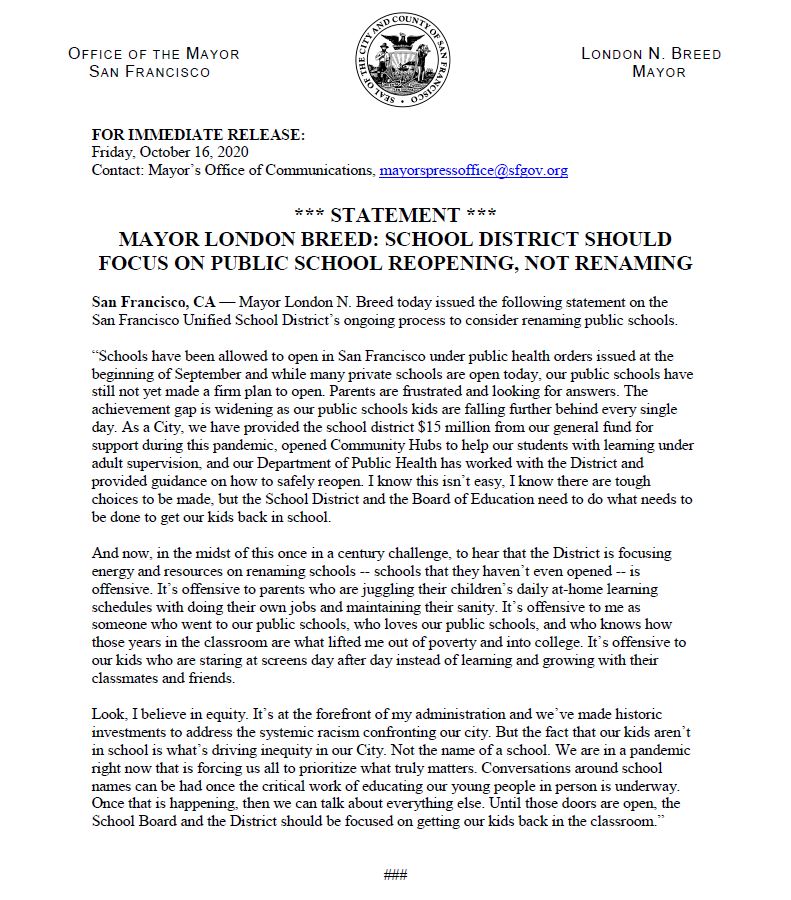
Teachers ignoring the achievement gap while instead pursuing expensive name changes has also been an issue in San Francisco where Mayor London Breed issued a statement that chastised teachers for creating a distraction about proposed school name changes while neglecting their students as they fall further behind in developing their academic skills.

Breed wrote in an October statement that the city provided the San Francisco Unified School District with $15 million from the city’s general fund for support during the pandemic and there was an expectation that the money would be used to help reopen the schools. But teachers chose to pursue school name changes, which hurt students, particularly students of color and their parents who rely on public schools to lift young people out of poverty.

“And now, in the midst of the this once in a century challenge, to hear that the District is focusing energy and resources on renaming schools – schools they haven’t even reopened – is offensive,” Breed wrote. “But the fact that our kids aren’t in school is what’s driving inequity in our City. Not the name of a school.”

Community members are eager for the DLC to settle the name change issue. But they aren’t expecting a fair outcome. Community members have been called “racists” and “white supremacists” at public meetings and in emails from members of the Drake administration.

At last the October DLC meeting, Lagleva closed his comments with a final suggestion for a decision-making framework, “It’s important to think about who benefits, who pays and who decides.”

For many community members who oppose the name change, those questions have already been answered.

The next meeting of the Drake Leadership Council is this Thursday, Nov. 19 at 4 pm. There will be an opportunity to address the DLC. Please see the Sir Francis Drake High School calendar for details.

1 Comment

Filed under Drake name change, Uncategorized

Drake administration thwarts public survey on controversial renaming plan

Drake administrators and district trustees continue to use bullying tactics in name change process

Teachers regularly allow ex-students to attack alumni with slurs and insults

By John Geluardi

The Tamalpais Union High School District is continuing is underhanded tactics in the process to rename Sir Francis Drake High School. The most recent trick they’ve used is sabotaging a survey that sought the opinion of parents in the district.

At an early meeting of the Drake Leadership Council (DLC), an 18-member body consisting of teachers, parents and students, a conscientious student suggested surveying the students to see if there was strong support for the renaming of the school. A perfectly reasonable suggestion. In addition, the student had diligently researched how a survey could be carried out easily, quickly and at little expense.

But to the student’s surprise, at least three teachers on the DLC shut her idea down. “I don’t need to know what a bunch of sentimental conservatives think,” said Drama teacher Jasper Thelin said. Another teacher, Richard Marshall said this is not a democratic process and he had already made his mind up how he would vote and it doesn’t matter what the white students think.

Despite the teachers’ attempt to shutdown the survey, there was enough support on the DLC to seek public opinion in some form. They decided on a limited survey that would be sent out students, parents and teachers.

The limited survey was sent out on Monday, Nov. 16 and the school and Principal Liz Seabury immediately shut the parent survey down.

“I hope the alumni concern for HS 1327/Drake continues past this into what really matter at the school… becoming an antiracist school AND community. We’ll see in time,” Seabury wrote in a response to community member Brad Beedle who is a member of the “No Name Change” alumni group.

The email suggests that Seabury believes the entire Drake community is racist though she offered no explanation for such a hostile and unfair claim. Seabury did not respond to emails asking for clarification.

Putting the kibosh on the survey is the latest trick the Drake administration and the school district has used to power through its agenda and deprive the DLC of relevant information as they wrestle with a serious decision that will have significant consequences on the school’s budget, community trust, good faith support and school programs, many of which are designed to close Drake’s conspicuous achievement gap, which Drake teachers are unable or unwilling to discuss for undisclosed reasons.

The name change process is a case in point. The school administration has unnecessarily divided the community with its lack of transparency, arbitrary actions, spending of thousands of dollars on controversial project that is not even approved and a pattern of intimidation in which community members are regularly subjected to, without basis, vile accusation of racism, white supremacy, and agism which has resulted in students and community members being fearful of district and administration retaliation.

The next meeting of the Drake Leadership Council is this Thursday, Nov. 19 at 4 pm. There will be an opportunity to address the DLC. Please see the Sir Francis Drake High School calendar for details.

Leave a comment

Filed under Uncategorized

Deconstructive Acts at Drake High School

An image of the vandalism carried by a Drake parent who was working with school faculty

The Tamalpais Union High School District has used vandalism, intimidation and secrecy to exert its power on the school community

By John Geluardi

As the renaming of Sir Francis Drake High School progresses a theme has emerged in the actions of the Tamalpais Union High School District… Destruction.

When looked at closely, the school district’s effort to change the 70-year-old high school’s name lacks anything that’s new or constructive in terms of concepts, programs or tangible value to students. The way the school district has only imposed hostility, secrecy and mistrust through a series of destructive tactics that are designed to achieve a goal – the destruction of a historical name.

The district’s theme of destruction made itself known with the sudden removal of the school’s name from the front of the school building on July 29. There was no public discussion, not warning, just the surprise removal, which was designed to catch the Drake community off guard, according to an email sent by School Board Trustee Cynthia Roenisch mailed to Drake administrators in July.

Even Drake employees were caught unaware. In one email to Principal Seabury sent on July 29, a school employee expressed shock and alarm that community members who opposed the name change had no opportunity to speak.

Seabury claimed the name was removed because of threats of vandalism. “I know this is a bit of a fast move,” Seabury wrote and added the removal had been planned in secret for the previous month. “Due to the potential threats of vandalism to the school, we felt we needed to bring it down today.”

But what Seabury failed to mention was that the threat of vandalism was coming from Drake teachers, Kendall Galli, Dan Freeman and Richard Marshall who were advocating for the destruction of school property in a series of emails that included Principal Seabury and her two vice principals.

In fact, according to Seabury, the school was vandalized on the weekend of July 25. Someone had covered the image of Drake’s ship, the Golden Hind that was on a mono totem near the school’s entrance.

The exact extent of the vandalism was unknown because Seabury never reported it to police despite receiving an email on July 29 that identified one of the vandals, a parent who was in regular contact with the teachers who were advocating for the destruction of school property.

The district continued to destroy the trust of the community by hiding the cost of the surreptitious name change. The cost of removing the name, temporarily renaming the school HS # 1327, storage of Drake memorabilia, letterhead, publication, graduation materials and most of all legal fees related to the district’s irregular tactics, all have been kept secret, which violates government transparency laws.

In addition, the district has been very destructive towards the community which has sustained the high school for 70 years. During two of three community “listening sessions,” people who claimed to be recent graduates repeatedly described the comments of community members who opposed renaming the school as “racists,” and “white supremacists.”

Poor grammar, a misunderstanding of history, an overflow of passion and self-satisfied hostility is to be expected to a degree from young people engaging in political activism, but the startling thing in this case was that during the first two meetings Seabury and Vice Principal Chad Stuart sat silently and contentedly while their former and current students mindlessly hurled slurs at alumni.

By the third meeting, Seabury attempted to quell the insults and slurs, but was only marginally successful. The district destroyed community trust further when Vice Principal Chad Stuart manipulated the speaker list by cancelling 50 sign ups in exchange for a majority of speakers who favored the name change. The result of Stuart’s action was a 12 to one ratio of pro-name change comments.

Now the Drake Leadership Council (DLC) is, after the fact, considering whether to approve the name change. But even that process has been broken. The DLC, which is made up roughly of an equal amount of teachers, parents/community members and students, will vote on what is no doubt a foregone conclusion to remove the name.

The teachers have undue influence over the students just by nature of their roles and the parents/community members are neophytes to the ways of council and the nonteachers are being herded into a predetermined decision by being deprived of information.

They are about to make a decision that will cost the school an estimated $430,000 during a time of unknown budget challenges due to Covid-19 and the DLC has been given no specific information about where that money will come from, how it will be solicited and spent. Nor have they been given any information about how much the unapproved renaming has cost thus far.

The district has illegally kept that information secret, but estimates by some school employees, who asked not to be named, estimate the expense so far could easily exceed $50,000 with the greatest percentage spent on attorney fees due to irregularities in the name change process such violations of the Brown Act, non-transparency, Drake faculty encouraging students to commit acts of vandalism and creating an environment in which Drake students are fearful of expressing their opinions for fear of retaliation from their teachers.

Drake teachers claim the name has to be changed for the sake of students of color, but the DLC has not considered the widening gulf in the school’s achievement gap. The DLC has failed to consider any potential options to a half-million-dollar name change that will make the all-white Drake faculty feel good about themselves, but will have no meaningful impact on the widening achievement gap, which the faculty is responsible for.

The school district has used racial intimidation, bullying, false demonization, vandalism, non-transparency and lies to achieve their dubious goals of changing a school name for symbolic purposes that best serve the self-congratulatory needs of the faculty.

The unfortunate thing is that the district did not need to bully a community that fundamentally supports the school. The decision to change the name was decided months ago by the district, which has the votes, the power, the paid hierarchy of lackeys and apparently, according to Seabury, access to large amounts of disposable cash.  They could easily have carried out the name change without the unnecessary bullying. But apparently they enjoy imposing their authority and hostility on their own community.

Contribute to The Braying Dog and see more stories about the name change at Sir Francis Drake High School.

Leave a comment

Filed under Drake name change

Drake Uses Secret Taxpayer Fund for Name Change

Tamalpais Union High School District Superintended Tara Taupeir uses questionable finance tactics for Drake’s proposed name change

School District remains silent about source of hidden expenditures

By John Geluardi

While Bay Area schools struggle to fund basic education programs amid unprecedented budget shortfalls related to the Coronavirus restrictions, a handful of Marin County teachers are imposing a half million dollar name change on Sir Francis Drake High School.

In late July, Tamalpais Union High School District Superintendent Tara Taupier, removed the name Sir Francis Drake from the school along with all other images, artworks and mascots related to Sir Francis Drake.

Taupier made the arbitrary, and possibly illegal, move without proper authority and with virtually no public discussion or analysis of the hefty cost to change the school’s name, which is estimated at $470,000. State law requires that no taxpayer funding be used for school name changes and that the school in question raise the funds through grants or community contributions.

But so far, Principal Liz Seabury and the district have been evasive about where the money will come from and whether the grant money will deprive needier school districts of basic funding needs. In various media interviews, Seabury has described the huge cost as nothing more than a “distraction.”

Despite state restrictions, Drake High School has already spent thousands of taxpayer dollars without any budgetary authority to do so. How much tax funding has been spent is unknown because the district and the Drake administration have been acting in secret. Principal Seabury and District Chief Financial Officer Corbett Elsen, to date, have refused to answer any questions about the expenditures. And the district has presented no plan to refund taxpayers for the secret expenditures to date.  

Best estimates have the preliminary costs for the name change at somewhere between $50,000 and $100,000 including a hefty sum to the law firm Dannis Woliver and Kelley, which has racked up heavy legal fees due to the Tamalpais Union High School District’s allegedly illegal maneuvers, including allegations of teachers calling for vandalism, which was carried out by a parent. The action was possibly sanctioned by Principal Liz Seabury, according to emails obtained through the California Public Records Act.

The school district removed the name prior to obtaining the required authorization from the Drake Leadership Council (DLC), a governing body made up of teachers, community members and students. The district is now retracing its steps by seeking DLC approval to change the school’s name.

However, the school administration has failed thus far to present the 18-member DLC with any financial reports, budget projections or strategies for soliciting large contributions from community members or foundations. According to Drake High School’s bylaws, the DLC must consider financial impacts under the state’s categorical funding laws.

The DLC councilmembers are typically not seasoned politicians or experienced bureaucrats. The only real experience on the DLC is represented by the six teachers and Principal Lez Seabury who already have undue influence over the students and parents on the council who are new to the process.

In addition to withholding financial information, Seabury and the teachers have been very aggressive in refusing requests by student DLC members to conduct any polls that might indicate whether students or community members support the name change.

Drake Principal Liz Seabury flanked by vice principals Chad Stuart, left, and Nate Severin

 “We don’t care what the students think,” said DLC teacher Richard Marshall on the record at a DLC meeting on Oct. 1. “This is not a democratic process. We don’t care what the students or community members think.”

Drake teachers claim the name change is vitally important because Sir Francis Drake was minimally involved in the slave trade in the 16th century when he was a very young man. At 23, Drake renounced the slave trade, became vociferous advocate against the practice and freed more slaves then he had ever transported on his two slaving voyages.

The Drake debate is no doubt valuable to engage in particularly because Marin is more than 70 percent white and the teaching staff at Drake is conspicuously white without exception.

But beyond the leafy boundaries of Marin County, the debate about school names becomes something of an absurdity. Cities like Oakland, Richmond and San Francisco where school districts are struggling to maintain classes, programs and feeding thousands of students and their families, during coronavirus budget cuts, such divisive fight over a name must seem solipsistic and self-important, particularly given Drake administrators are secretly spending huge sums of money, possibly illegally, to change the name.

Calling the name change efforts “offensive,” San Francisco Mayor London Breed chastised the San Francisco Unified School District for pursuing abstract name changes while neglecting the education of students of color who are losing critical ground.

“The achievement gap is widening as our public school kids are falling further behind every single day,” Breed wrote in her October 16 statement. “And now, in the midst of this once in a century challenge, to hear that the District is focusing energy and resources on renaming schools – schools that they haven’t even reopened – is offensive.”

According to the 2019 California Assessment of Student Progress test taken by 95 percent 11th graders in the Tamalpais Union High School District, Drake teachers failed African American and Hispanic students by yet again making no appreciable difference in the achievement gap.  

 The DLC’s next scheduled meeting is at 4 p.m. on October 29. Zoom information and links can be found on the Sir Francis Drake High School website.

If you liked this story, please consider ensuring more stories by contributing to the Braying Dog’s Gofundme site. Thank you.

2 Comments

Filed under Uncategorized

Drake Name Change Process Appears to be “Rigged”

By John Geluardi

Corrected version:

Community members are alleging the Sir Francis Drake Site Council, which will decide whether to change the school’s name is stacked with activist teachers whose votes in favor of the name change are a foregone conclusion.

And according to school emails obtained through the California Public Records Act, it looks like the community members may have a point.  

There are six teachers on the 18-member council and all six have written emails over the summer that show they strongly support the name change and some put a premium on activism. Several of the site council teachers called for vandalizing the school as a form of political action.  Other site council members include five students, four parents, two school employees and Principal Liz Seabury.

In addition to teachers who are expected to vote for the name change, there is one teacher, Jasper Thelin, who is serving his second term on the council. Teacher terms on the council are only for one year and it is unclear if Thelin was elected for 2020-2021 term or if he was appointed. The school has posted no election results for any of the teacher councilmembers and Seabury has not immediately answer questions about Thelin’s current term.

Thelin stated at the first site council meeting that he doesn’t care what the community thinks about the name change and those who are against it, are sentimental “conservatives.”. “I don’t need any more information,” Thelin said at the council’s first meeting. “I’ve already made up my mind.

The 18-member Site Council is charged with choosing a new name, hearing public input, deciding the process by which the school’s name will be changed and even if the name will be changed at all. The Council held a second meeting on Thursday, Oct. 1.

The school administration’s name change process has been fraught with irregularities and possible illegal activity including an alleged violation of the Brown Act. Many of the blunders and deceptive acts appear to have been caused by the district’s headlong rush to get the school name changed before the election on November 3, when Measure M, a special tax for educational purposes, will be considered. Board Trustee Cynthia Roenisch pressed the school administrators to act quickly to avoid community opposition. She lobbied heavily for a quick resolution and warned of the community getting organized to oppose the name change. “We have a parcel tax election in November, and some may create more friction if date is too far in future,” Roenisch wrote in a July 2 email. “…but we know Dixie was shit show and some of it was from lack of vision/tight timeline from the start.”

The three teachers who called for defacing the school are (click on links for emails) Site councilman Dan Freeman, who was one of the chief organizers behind the name change. He suggested defacing the school in the manner of “statue toppling.”

Site councilman Richard Marshall who used tortured logic to support his calls for defacing the school, which he said could “show respect” to students who do not want the name change, according to a July 17 email.

And site councilwoman Kendall Galli wrote an enthusiastic July 15 email. “Let’s tarp the ship with a camel colored tarp… and tarp or paint the back of the dugout, Galli wrote. “Let’s get the kids in NOW on the ground floor. “This is ACTION… and student lead.”

If the school hadn’t actually been vandalized, the teachers’ emails could be written off as the over-excitement of teachers bored during summer vacation. But some of the things described in the emails did happen on July 27. The name and ship on a stucco sign in the parking lot was papered over and an image of the school mascot was painted over.

Seabury insisted at the most recent site council meeting that Drake teachers are largely in favor of the name change and that the teacher site councilmembers were all fairly elected. However the election results are not posted on the Drake Site Council’s webpage.

As yet, there is no evidence that any of the teachers were involved in the vandalism, but there was an email from a witness informing Principle Liz Seabury that a parent was part of the defacing crew. Seabury has refused to divulge the parent’s name.

The next meeting of the site council is on Oct. 15. Information about the site council can be found at https://www.tamdistrict.org/domain/317.

Contribute to the continued coverage of the Drake Name Change.

14 Comments

Filed under Uncategorized

The Mythical End of the Outlaw Pot Farmer

By John Geluardi

3_History_Lessons_of_Medical_CannabisWhen California voters approved the legalization of marijuana last year, they did so, in part, because of a promise. A promise made by advocates of Proposition 64 who claimed black market weed farming would come to an end, the environment would be protected, weed would be wholesomely grown, and all harvests would be tested to assure the safest possible product is sold in a new and thriving marketplace.

That promise was present in the text of Prop. 64: “By legalizing marijuana, the Adult Use of Marijuana Act will incapacitate the black market and move marijuana purchases into a legal structure.” But the ballot measure failed to mention exactly how the black market would be “incapacitated.” Nonetheless, many supporters chose to believe that legalization would shutter dangerous illegal indoor grows in residential neighborhoods and sprawling warehouses and outdoor grows in scenic parklands.

Voters also wanted to think the organized crime operatives who watch over those massive outdoor grows would take their automatic weapons, banned pesticides, and poor hygiene to other environs in other states.  And there’s a lot at stake. Control of the darker forces of black-market farming practices is critical to protecting parks, water resources, and aquatic life. The National Forest Foundation estimates that each year huge amounts of harmful chemicals are dumped in state forests, including 9,000 pounds of rodenticide, 70,200 pounds of fertilizer, 4,800 gallons of insecticide, and 300 tons of assorted garbage.

But since voters approved Prop. 64 a year ago, state bureaucrats, eagerly anticipating high tax revenue from the estimated $13 billion industry, have been softening their position on the black market, perhaps in an effort to dial back expectations. “It’s going to take some time,” admitted Lori Ajax, chief of the state’s Bureau of Cannabis Control, told the Los Angeles Times. “While it’s unlikely that everyone will come into the regulated market on Day One, we plan to continue working with stakeholders as we move forward to increase participation over time.”

But how realistic is it that state and local government agencies will bring illegal pot farms into the regulated market? Legalization becomes the law of the land in January, but it’s already clear that the onerous criteria for state and local compliance and the punishing fees for applications, inspections, and property upgrades are serving as a huge obstacle for farmers who want to abandon the black market and trade in the regulated one. And state officials have yet to figure out how to effectively lock California black-market pot farmers out of the new legal marketplace.

In fact, there’s little doubt that California’s illegal pot growers will continue to thrive09-med-marijuana-history within the state even if they are locked out of the new, regulated marketplace. There are already well-established trading routes to other states and countries. California growers harvest 13.5 million pounds annually (a low estimate), but the state only consumes roughly 2.5 million pounds, according to the state Department of Food and Agriculture. That means cannabis farmers ship roughly 11 million pounds out of state every year. The California Bureau of Cannabis Control is still in the process of fashioning new regulations that will undoubtedly prohibit the transportation of weed across state lines, but it’s unclear if the bureau’s inspectors will be able to crimp the flow of black market pot that has been crossing state borders for decades.

In the 44 years since the Drug Enforcement Administration was formed, well-funded government agencies, often working in tandem with U.S. military forces, barely put a dent in California’s illegal pot farming industry. According to the DEA, an intense effort of combined local, state, and federal forces was only able to eradicate 2.6 million pounds in 2015. Creating a new layer of confusion, California’s local governments are now creating a crazy quilt of opposing regulations.

In San Francisco, Oakland, Berkeley, and Richmond, pot farming mostly takes place indoors. Thousands of homes and warehouses have been converted into discrete farming operations, many with jury-rigged electrical systems that are prone to fires related to overloaded circuits. In Richmond, which has regulations in place for permitting indoor legal pot cultivation, there hasn’t been a strong-armed effort to shutdown illegal grows. In one case, an indoor pot farmer was growing in a 70,000-square-foot warehouse, and instead of shutting down the grow and ripping out the plants, the city decided to help the owner make the operation a revenue generating business. “The owner of the operation didn’t have a criminal record and was willing to work with the city,” said Planning Director Richard Mitchell. “He paid all the application fees, and he’s now making needed upgrades to the building to comply with city cannabis and zoning ordinances.”

This tactic is also being used in Humboldt County, where there is a serious problem with pot-farm-related environmental damage to soil, waterways, and aquatic life. The county planning department has sent out letters to known outdoor pot farmers telling them to get on the waiting list for county permits and cease environmentally damaging practices. If growers honor those requests, they can continue to operate on a temporary permit. If they don’t, they will face a $10,000 fine for each day they continue to grow weed. “People who are in the permit process are not targets,” said county Planning Director John Ford, adding that the county’s primary goal is to put a halt to illegal farms that are causing environmental damage. “My primary hope is that we get sites into compliance.”

hippiesHezekiah Allen, director of the California Growers Association, said Humboldt County’s approach will likely become a model for counties that want to responsibly regulate cannabis cultivation. “It’s a popular model with the California Association of Counties growers in Humboldt who are telling me that it’s workable,” Allen said. “It’s a shift to tax liens and civil actions and away from uniformed officers breaking down doors and chopping down plants.”

California’s new marijuana market is full of promise. It will create thousands of jobs and as much as $1 billion will flow annually to state coffers. But despite the best efforts of bureaucrats and law enforcement, it doesn’t appear that the outlaw pot farmer will be riding off into any sunsets.

Leave a comment

Filed under Uncategorized

Growing Clean Weed to Meet State Regs

By John Geluardi 

Grower Joseph Snow practices clean growing method based on the philosophy of rebel Japanese farmer  

Joseph Pic

As California’s newly legalized cannabis market gears up for its January launch, pot farmers are looking for ways to meet new safety standards for their harvests. And in the rush to employ safe farming practices that result in high-quality yields, one California grower has adapted the farming philosophy of Masanobu Fukuoka, an iconoclastic Japanese farmer who bucked the chemical-based farming practices of the early 20th century, and has been producing top-quality cannabis that requires no pesticides, fungicides, or chemical fertilizers and naturally repels molds and insects.

Joseph Snow, who grows at an undisclosed Bay Area location, is still in the experimental phase but has nonetheless been growing small, indoor crops of cannabis that have been passing laboratory tests with no sign of pesticides and impressively low levels of molds and fungi. Moreover, Snow’s grows have been producing average-size yields of highly potent cannabis.

During a chat last week, the 28-year-old Snow folded his 6-foot-5-inch frame into a chair at Au Coquelet Cafe & Restaurant in Berkeley. He was born in New York but was mostly raised and educated in Israel. And when he talks about the principles of growing cannabis, he becomes quite passionate. “I’m not in this for a hippie-dippy notion of growing organic plants,” said Snow. “That is the goal, of course, but I’m really in it for the science.”

Earlier this month, the California Bureau of Cannabis Control released a nearly 500-page tome of proposed regulations that will set standards for everything from licensing for growers and dispensaries to acceptable noise levels for outdoor growing activities. Under this extensive oversight, each individual cannabis plant will be “tracked and traced” from “seed to sale” with particular attention paid to the presence of contamination levels on plants bound for the marketplace. Using sophisticated testing methods, state-certified laboratories will test cannabis products to ensure they meet minimum levels of pesticides, solvents, fungus, and mold.

This testing took on some urgency recently after Anresco Laboratories conducted tests on all of the cannabis featured at the HempCon Festival held in San Francisco in August. The San Francisco-based laboratory discovered that 80 percent of the cannabis at the festival was contaminated with unhealthy levels of solvents, pesticides, molds, fungus, or various bacteria.

In addition, research data compiled by Integral Ecology Research Center show that Humboldt, Mendocino, and Kern counties have elevated levels of chemicals often used in banned pesticides. Chemicals such as carbofuran, diazinon, and zinc phosphide, all of which are dangerous to human health, have been found in creeks and rivers that feed into sources of drinking water. Perhaps most alarming, earlier this year a California man undergoing cancer treatment at UC Davis died from a lung infection that doctors believe was caused my ingesting marijuana tainted with fungus.

Kyle Borland, a cannabis spokesperson with Anresco Laboratories, said they applied the state of Oregon’s official standards when testing the HempCon cannabis. “Admittedly, the man who died had a weak immune system from his cancer treatment, but we took a strict approach to testing the HempCon cannabis, because we want to be assured that medically compromised users will not be at risk,” Borland said. “We ran tests on the HempCon cannabis twice, and the vast majority of it would not have been allowed into the Oregon marketplace.”

Snow is one of many California growers who is applying reliable methods to grow top-quality cannabis that’s safe for the newly legal marketplace. But Snow’s methodology is largely unknown in the state. And despite facing a host of doubters, he’s had a great deal of success and has a stack of test results from Pure Analytics Laboratory in Santa Rosa that shows he’s on the right track. Snow said his techniques can be easily adopted by growers who want to produce cannabis that is essentially organic: free from chemical contaminants. “That’s really the goal,” Snow said. “Growing outdoors will produce even better and safer product.”

Snow based his growing theory on Masanobu’s book, One-Straw Revolution, which has inspired a natural-farming philosophy internationally. Masanobu’s theories have been successfully applied to growing fruits and vegetables, but they have not been widely applied to cannabis cultivation. “There is very little information about Masanobu’s theories in relation to cannabis growth,” Snow said. “That’s why this method is so revolutionary.”

The principles are basic: a good environment in terms of healthy, chemical-free soil is required, good lighting (outdoors is best), moderate temperature control, and lots of worms. “A good combination of red worms and European night crawlers in the mulch seems to work best,” said Snow, adding that his mulch is simple as well: rice straw and untreated plant material from previous grows.

“Hard work and careful attention to the plants is mandatory, but if those simple things are provided for the plant, it will naturally produce healthy amounts of resin and terpenes, which effectively protect the plant from mold and fungi,” Snow said. “It’s the growers who neglect their plants that find themselves in trouble that have to spray their crops with dangerous amounts of chemical herbicides and pesticides.

Snow’s methodology sounds very similar to biodynamics, an organic method that dates back to the 1920s. Snow said his theory, which he calls “Natural Farming,” is within the rubric of biodynamics, except his practices are greatly simplified. For example, Snow does not compost his soil or use any nutrients as some biodynamic methods call for. And Snow avoids any practices that call for celestial calendars or moon charts, which are common in biodynamics. “I pare down everything to its most simple,” Snow said. “I want to remove anything that is unnecessary and still grow top-quality crops.”

Reggi Gaudino, vice president of scientific operations at Steep Hill Labs in Berkeley, said good test results for chemicals and mold are not unusual with small grows, but with larger grows, it’s much tougher to achieve good outcomes. “Once you scale up, it becomes harder to avoid microbe contamination,” Gaudino said.

Snow agreed that larger grows require more work but said it is possible to grow high-quality plants with virtually no pesticides or other chemicals provided the grower does not get greedy and hires the people needed to properly care for the plants and their environment.

“There have been a lot of people who doubt the methodology I’m using, but they produce excellent results, and I’m happy to show it to anyone whose interested,” Snow said.

Snow said he is unsure when he will move his farm outdoors, though he’s looking forward to growing with sunlight. “It will take longer to harvest, but the best place to grow is the most natural place and that means outside.”


Leave a comment

Filed under Uncategorized

The Deafening Silence of Nicole Brown Simpson’s Akita

By John Geluardi

akitaI was pleased Sunday night when “O. J. Made in America” won the Academy Award for Best Documentary. It is by far one of the most thorough documentaries I’ve seen and it recasts the killings of Simpson’s ex-wife Nicole Brown Simpson and Ronald Goldman and the subsequent murder trial into a powerful context for those who watched the documentary’s five remarkable episodes.

While watching the documentary, I was struck by a scene that occurs about half way through episode 3 when Al Cowlings, at the end of the infamous low-speed chase, pulls the white Bronco into the driveway of Simpson’s Rockingham estate. In the vehicle’s backseat, the fallen sports hero and suspected murderer is supposedly suicidal and resting his chin on the barrel of a handgun while clutching family photographs.

During the scene, taken from helicopter-shot news footage, Cowlings gets out of the Bronco and a standoff between Simpson and the Los Angeles police begins. The scene is tense. Everybody is wondering if the police will shoot Simpson who is emotional and armed. Simpson’s family, the crowds who had poured into Brentwood to be part of celebrity history, the helicopter pilots hovering just overhead and the millions of Americans who watched the scene unfold on live television, all are holding their breath

But it wasn’t the noisy drama of the scene’s central focus that fascinated me. I was drawn to a very short, but compelling scene within the scene. About 10 feet in front of the Bronco, Nicole’s white and brown Akita, Kato, stands looking directly at the Bronco’s wretched occupant. The dog’s presence stuck me because the Akita — who by coincidence had the same name as the quirky human houseboy Kato Kaelin — was the only witness to the brutal murders of Nicole and Goldman.

On that June night in 1994, it was Kato who began to bark and wail “plaintively” at 10:15 p.m., which set the condemning murder timeline that showed Simpson had time to butcher his ex-wife and Goldman and still make it back to the Rockingham estate in time meet limo driver Allan Park who drove Simpson to the airport for an 11:45 flight to Chicago. It was also the Akita who went to the street, his paws soaked in Nicole’s blood, to alert neighbors that two bodies were lying on the walkway of Nicole’s home at 325 Gretna Green Way.

While there are no known human witnesses to the deadly attack, the Akita saw who killed his beloved owner and the young waiter whose only crime was being in the wrong place at the wrong time. The dog was never interviewed by police nor did he give testimony at trial, but five days after the killings, Kato was there waiting when Simpson pulled into his driveway with a dozen police cars in tow. Like Dr. T.J. Eckleberg overlooking the Valley of Ashes, Kato stood in front of the Bronco silently looking at Simpson while chaos surrounded man and dog.

Bred in Japan’s remote northern mountains, the Akita is the most ancient of Japanese dogs. We can only guess what Simpson experienced when afixed by the dog’s primordial eyes set deep in the dog’s bear-like head. Kato was the one being who knew beyond a shadow of a doubt of Simpson’s terrible transgression. I like to think the sports hero and pitchman was at that moment inescapably confronted with his abhorrent crime and, for at least a moment, slipped deeper into a morass of oppressive guilt. I also like to think that Kato’s knowing gaze leveled at him all those years ago still occasionally wakes Simpson from fitful sleep in his high desert prison cell at the Lovelock Correctional Facility

Like many involved in the trial, Kato became a minor celebrity. He even had his own spoof autobiography:“O.J.’s Dog Daze,” which was published in 2001 and came with a paw print autograph.

Fortunately Kato landed well. Once the trial was over and the media frenzy died down, Kato ended up in the beach town of Dana Point where he was cared for by Nicole’s parents, Judi and Louis Brown. After a long life, Kato died in October, 2004. The Browns are said to keep his ashes under the family piano, which was Kato’s favorite spot to curl up and watch over family activities with those deep-set, Akita eyes.

11 Comments

Filed under Academy Awards, Akitas, Crime, Dogs, Ezra Edelman, Murder Trial, Nicole Brown Simpson, O.J. Made in America, Uncategorized

Democrats Choose Another Dead End Road

By John Geluardi
Hillary Clinton, Tom PerezThe Democratic National Committee has decided to stay on a lost road risking more failure, loss and corruption. By electing former Labor Secretary Thomas Perez, the party has signaled that its traditional base will continue to be strip teased while in the backroom, corporate interests are fully serviced.

Perez won the election on Saturday by beating progressive favorite Minnesota Rep. Keith Ellison by a second-round vote of 235-200. Unfortunately, Perez is a symbol of how Democrats have abandoned their base. As President Barack Obama’s labor secretary, Perez was a supporter of the Trans Pacific Partnership despite the strong opposition of nearly every major U.S. union. As a Clinton campaign adviser, Perez sewed division among Dem voters by arguing for whitewashing Bernie Sanders’ campaign with false claims that Sanders’ support was driven by whites.

Perez’s victory will assure the corrupt and  failed wing of the Democratic Party will stay in power, if that’s a term that can any longer be affixed to the weakened political faction symbolized by a jackass and characterized by rent seeking. Under Obama’s two pro-corporate terms in the White House, the party suffered unprecedented losses. Democrats list of losses is long and depressing. It includes the White House, the Senate, Congress and more than 1,000 seats in state legislatures and a dozen governors’ mansions.

Now, more than ever, it’s critical Democrats revitalize the party. President Donald Trump is poised to roll back nearly all the hard fought advances in environmental policy, race relations, Wall Street regulations (such as they are) and what little political influence labor unions have been able to grasp onto.

bern-crowdAnd there’s no disagreement over which party has the energy to revitalize the Democratic Party. The primary campaign of Sen. Bernie Sanders made it clear through the large rallies, individual donations and resonating message, that Democrats realize they’ve been abandoned by the party’s establishment. And the DNC has as much as admitted the party establishment is uninspired, outdated and corrupt by working to undermine the party’s own voters by attempting to suppress Sander’s surging popularity through Deborah Wasserman and John Podesta’s dirty tricks.

With the election of Perez, Democratic voters can only hope that fear and hatred of President Donald Trump will be enough for the Party to start winning elections again. Otherwise, short of finding another charismatic Barack Obama, the party establishment is embarrassingly lacking in inspiring candidates. Nowhere is this more problematic than the Rust Belt. Democrats need to bring Ohio, Pennsylvania and Minnesota back into the fold, and unless Perez can break free from the Clinton-designed Democratic establishment, the Party will continue to flounder on a road to nowhere.

2 Comments

Filed under Corruption, Democratic Party, Journalism, Presidential Primaries, The Convention, Uncategorized